Collaboration Is No Longer Optional for Adult Creators in 2026
Fan-based platforms changed the adult creator economy - giving creators control, but increasing pressure to stay relevant. After studying real creator journeys, one pattern is clear: collaboration is no longer optional. It’s infrastructure.

Key Takeaways
- Fan-based platforms changed who controls content and who carries the pressure
- Audience switching is faster than content evolution
- Collaboration has become infrastructure, not a growth experiment
- Creators who approach collaboration strategically last longer and burn out less
Introduction
In the fan-based adult content landscape, collaboration is no longer optional.
It has become infrastructure, necessary to maintain followers and increasingly essential for growth. Fan platforms gave creators control, but they also made attention fragile.
In 2026, collaboration is how adult content creators stay relevant in a market built on constant choice.
Why Collaboration Is Now a Required Tool for Success
The shift from studio-led adult content to fan-based platforms fundamentally changed the business model.
Creators gained:
- Ownership of content
- Direct access to fans
- Control over pricing and branding
But they also inherited everything else:
- Engagement responsibility
- Retention pressure
- Continuous novelty demand
- Revenue volatility tied to attention
In studio models, visibility was shared and paced. In fan platforms, visibility is individual, constant, and unforgiving.
Creators responded logically:
- Better production
- Story-driven content
- Tighter niches
- More frequent posting
Yet even high-quality solo creators began to plateau. The issue wasn’t effort or creativity. It was choice saturation.
Fans now have thousands of comparable options, low switching friction, and shorter loyalty cycles. In that environment, solo momentum decays faster - no matter how good the content is.
Collaboration emerged not as a trend, but as a structural response.
Real-Life Use Cases That Prove Collaboration Matters
1. Creators Who Rose Fast - Then Disappeared
One of the most uncomfortable truths of fan-based platforms is how many creators who dominated conversations in 2020–2021 are no longer active today.
These weren’t low-effort creators. Many were early movers who benefited from timing, novelty, and intense fan attention.
A commonly cited example is Belle Delphine. Her rise on fan platforms was explosive driven by curiosity, meme culture, and parasocial intensity. But that same model demanded constant escalation. When novelty fatigue set in, sustaining engagement required exponentially more effort, with diminishing returns. Eventually, stepping away became the rational choice.
A similar pattern played out with several early viral creators whose names once dominated fan-platform discussions but are now largely inactive. They didn’t collapse publicly. They opted out privately.
Across these cases, the pattern is consistent:
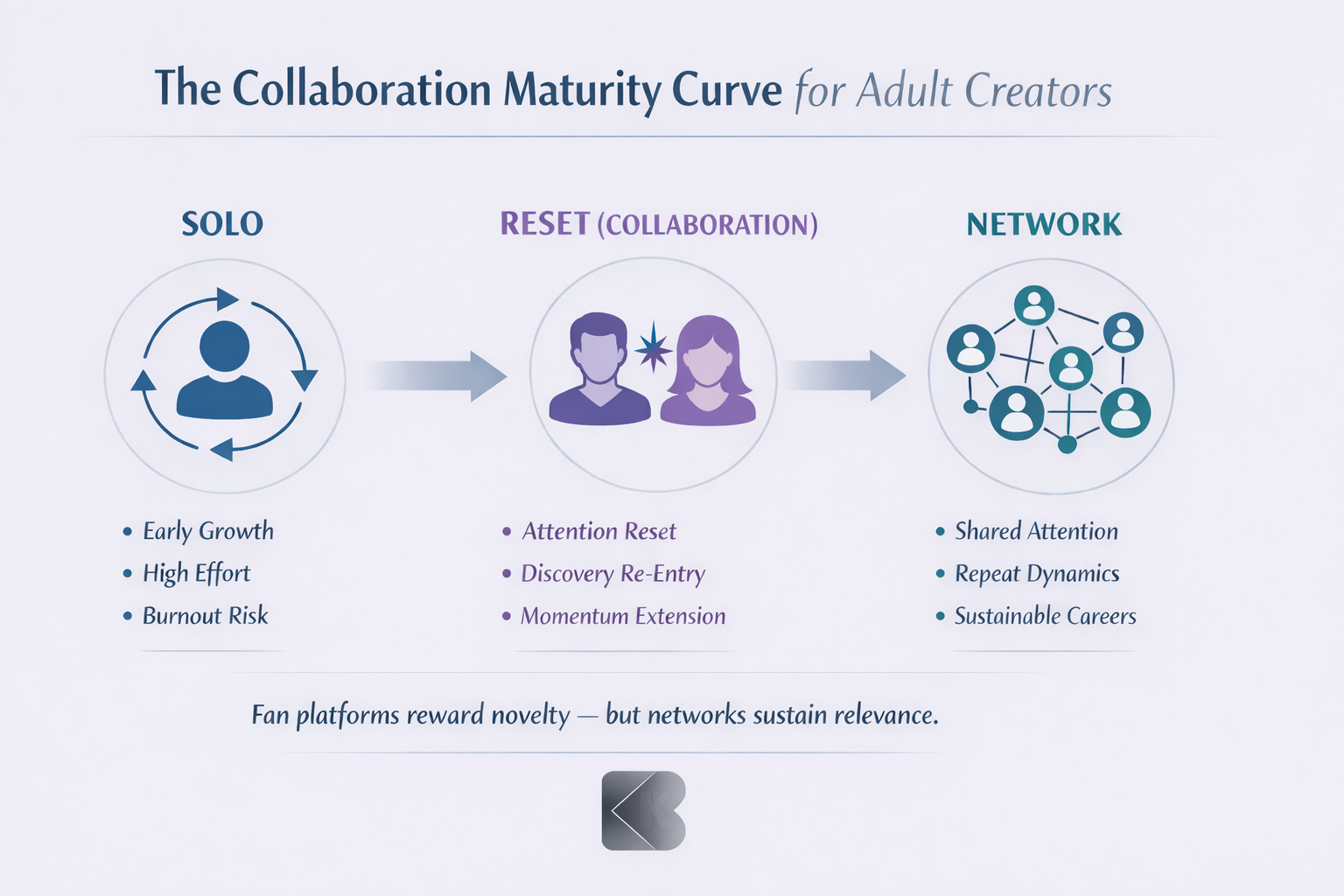
Early phase
- Explosive subscriber growth
- Strong parasocial bonding
- Mostly solo content
- High personal engagement with fans
Later phase
- Faster fan churn
- Pressure to constantly “top” previous content
- Revenue volatility despite effort
- Burnout without visible warning
The key insight isn’t that these creators “failed.”
It’s that solo success on fan platforms has a shorter half-life than most creators anticipate.
Without collaboration, all novelty pressure sits on one person. And in the fan economy, novelty is the most expensive currency to sustain alone.
2. Collaborations That Reset or Created Stardom
On the other side of the spectrum are creators whose trajectories changed because of collaboration, not because the collaboration was bigger, but because it reinserted them into active discovery loops.
A widely cited example is Lena The Plug. Her early success was driven by strong solo branding and personality-led content. But what sustained her relevance over time was her willingness to collaborate publicly and strategically. Each major collaboration didn’t replace her identity - it reframed it, pulling in new audiences and resetting attention without requiring constant escalation of solo content.
Another clear pattern appears with creators like Angela White, whose longevity is closely tied to repeated, cross-niche collaborations. Rather than relying on static fan loyalty, she consistently reintroduced herself to new segments of the audience through collaborations that emphasized chemistry and professionalism over shock value.
In these cases, collaboration functioned as:
- A re-entry into discovery
- A relevance reset for plateauing audiences
- A way to stay visible without increasing posting intensity
The critical insight is this:
Collaboration works best as an attention reset, not as an exposure stunt.
Creators who treat collaboration as a way to refresh audience perception — rather than “borrow followers” - are the ones who extend their peak years.
3. When Collaboration Becomes a Creator’s Identity (Fan Demand)
The strongest evidence that collaboration has become infrastructure doesn’t come from creators - it comes from fans.
Across fan platforms, a consistent behavior pattern has emerged:
- Fans explicitly requesting specific collaborators
- Comments asking when certain pairings will return
- Subscribers staying active longer during repeat collaborations
In many cases, creators become known not just for who they are but who they create with.
A clear example of this dynamic-driven fandom can be seen in ecosystems like Plug Talk, where the appeal isn’t a single personality but the rotating chemistry between creators. Fans don’t subscribe for one person, they subscribe for the interaction.
Similarly, premium studios like Vixen Media Group have long understood that repeat pairings outperform random casting. Audience memory forms around relationships, not isolated performances. That same psychology now plays out directly on fan platforms but creator-led.
When this happens, collaboration stops being a tactic and becomes:
- Part of the creator’s brand
- Part of the value proposition
- A retention mechanism
At that point, creators aren’t just selling content, they’re selling continuity and evolution.
This reveals a deeper truth about fan psychology:
Fans don’t just follow creators. They follow chemistry, progression, and shared narratives.
How You Should Approach Collaboration (This Is Where Most Creators Get It Wrong)
Not all creators should collaborate the same way. Most advice fails because it ignores creator stage.
If You’re a New Adult Content Creator
Your goal: discovery and credibility not scale.
How to approach collaboration:
- Start with creators slightly ahead of you, not far above
- Prioritize brand alignment over follower count
- Use low-risk formats (shared drops, guest appearances, bundled content)
- Be selective - early identity matters
What to avoid:
- Chasing big names too early
- Over-collaborating and diluting your positioning
- Treating collaboration as validation instead of strategy
For new creators, collaboration should introduce you - not redefine you.
If You’re an Established Creator
Your goal: engagement renewal and revenue stability.
How to approach collaboration:
- Plan collaborations proactively, not reactively
- Mix predictable collaborations with occasional unexpected ones
- Use collaboration as a retention tool, not just growth
- Track impact beyond subscriber spikes (churn, resub rates, engagement depth)
What to avoid:
- Waiting until numbers drop
- Repeating the same type of collaboration endlessly
- Treating collaboration as filler content
For established creators, collaboration is how momentum is preserved.
Final Thought
Fan platforms didn’t just empower creators - they shifted the entire burden of attention onto them. After studying hundreds of creator journeys, one pattern keeps repeating: solo success arrives fast, but isolation makes it expensive to sustain.
That insight is what led to Miss Bliss’ collaboration-first philosophy. Not as a growth hack, but as a way to reduce pressure, extend relevance, and help creators build careers without burning themselves out.
In 2026, collaboration isn’t optional. But collaboration without structure is just noise.
Creators who treat collaboration as infrastructure build careers. Miss Bliss exists to make sure they’re rewarded for it - not exhausted by it.